
Simaudio • Moon 110LP v2 Phono Stage
Canadian high-end audio company, Simaudio, has been around for more than four decades. Their extensive product range consists of numerous items including DACs, integrated amplifiers, streamers, pre- and power amplifiers, and phono stages.
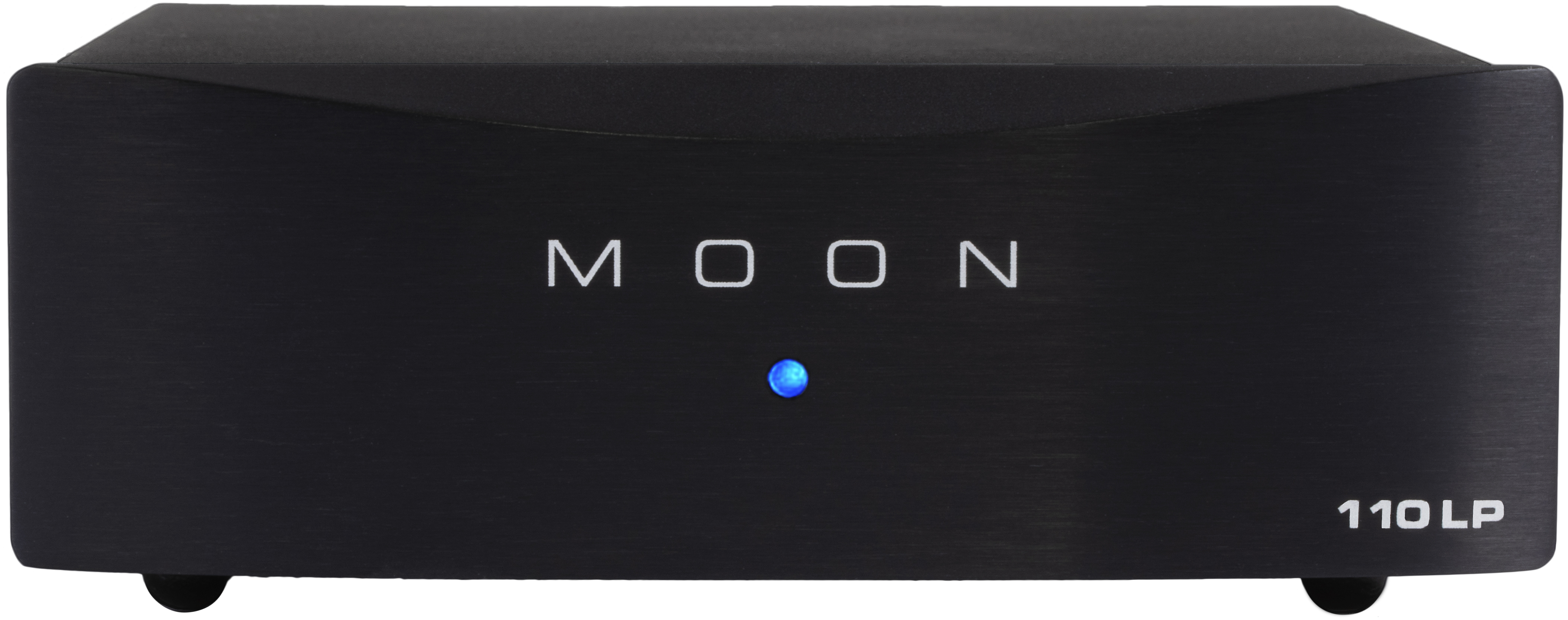
There are four phono stages in Simaudio’s current line up. At the top we find the Moon 810LP Reference balanced dual-mono phono stage, closely followed by Moon 610LP. Slotting below these full-sized phono stages are the Moon 310LP (which we reviewed a while ago and were very favourably impressed. Last, but by no means least, is the entry-level Moon 110LP v2; it is the latter that is the subject of this review. Our review of version one of the 110LP can be found here.
Technical Description
The Moon 110LP v2 is a diminutive solid state phono stage, and replaces the previous generation’s Moon 110LP. It features one pair of single-ended inputs and one pair of single-ended outputs. It also has user-selectable gain, input loading resistance, input loading capacitance, and the choice of RIAA or IEC equalisation.
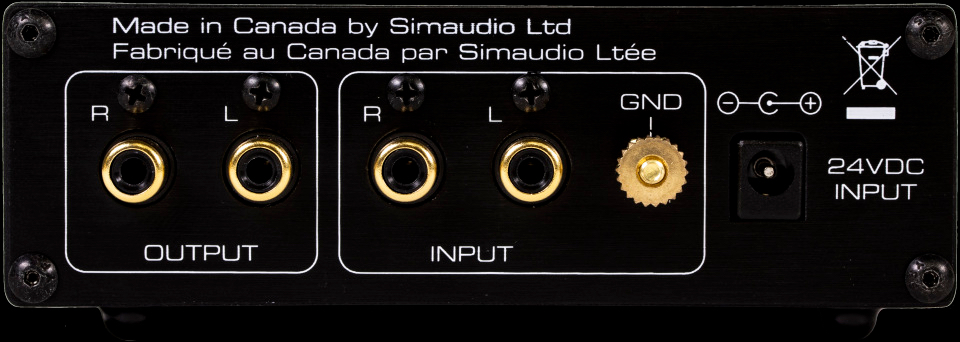
The rear panel contains the gold-plated input and output RCA sockets, a gold-plated earth post, and an input socket for the 24 VDC power. The latter is implemented by a wall-wart power supply. It’s no secret that I’m not a fan of wall-warts, but I understand that compromises must be made at this price level, and using a wall-wart is a cost-effective way of keeping potentially noisy mains filtering circuitry away from the sensitive amplification circuits. Talking of power: the 110LP v2 is intended to be powered on semi-permanently, so there is no mains switch.
The front panel, which is made from a 9 mm thick sheet of machined aluminum, has a black anodised finish. It houses the blue power LED.
Despite having similar features to the version 1 110LP, the version 2 is a clean sheet design with almost nothing in common with version 1. For example, the version 1 PCB was double sided (two layer) whereas the version 2 PCB has four layers: a dedicated power plane, a dedicated ground plane, and two signal layers.
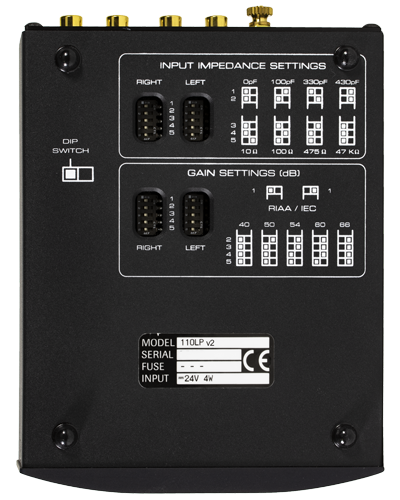
Version 1 of the 110LP had several sets of jumpers on the circuit board for selecting the gain and the loading options, but on version 2 there are two pairs of DIP switches accessible from the bottom of the case. These switches are used to select the gain (40, 50, 54, 60, or 66 dB), the input impedance (10 Ω, 100 Ω, 475 Ω, or 47 kΩ), the input capacitance (0, 100, 330, or 430 pF), and the equalisation curve (RIAA or IEC). To facilitate easy changes of the DIP switches without the possibility of scratching the case, Simaudio thoughtfully supply a plastic pen-like tool for this purpose.
Simaudio’s Product Director, Dominique Poupart, was kind enough to tell me some technical details about the Moon 100LP v2’s implementation. The phono circuitry uses a mirror-imaged, dual-mono single-ended configuration that is optimised for short signal paths and low-level analogue accuracy. The four-layer PCB and inductively filtered power topology ensure a very low noise floor. High quality components are used throughout; for example, the polypropylene film capacitors used in the RIAA equalisation circuits are individually hand-matched to close tolerence values. This allows Simaudio to reach a more accurate frequency response, and in my experience is an uncommon attention to detail at this price point.
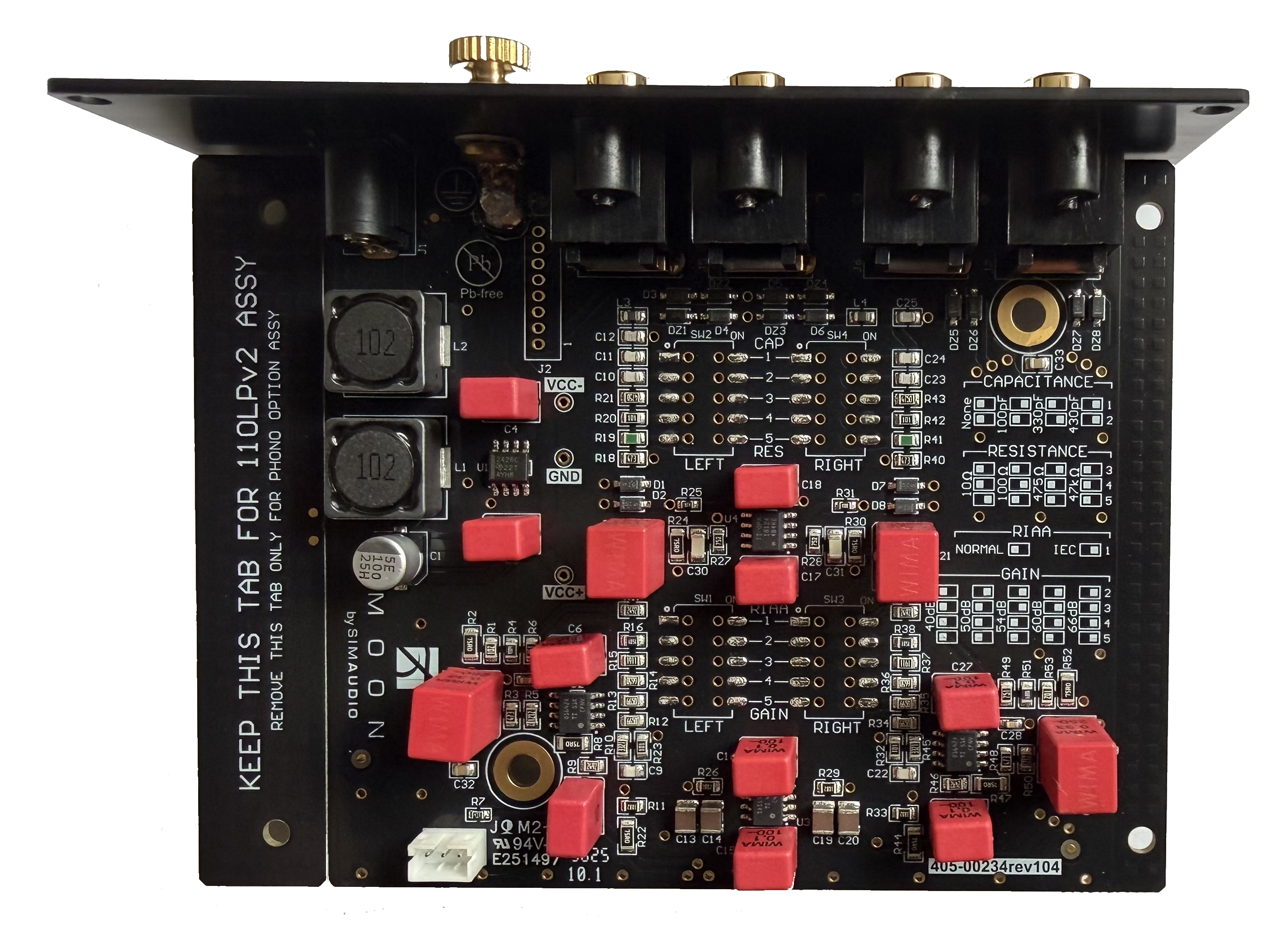
The previously mentioned DIP switches are not in the signal path, avoiding any potentially deletarious effects.
Setup and Listening
My Lyra Atlas reference cartridge is a low output moving coil design, which pretty much dictated that I positioned the DIP switches for 66 dB of gain, 0 pF of loading capacitance, and 100 Ω of loading resistance.
Simaudio recommends leaving the 110LP v2 powered on semi-permanently, so, with one or two brief exceptions to facilitate moving gear around, I left it powered up throughout the entire review period (this also helped build up the recommended 300 hours of break-in time). I also played numerous records through the 110LP v2 as background music before starting my serious listening.
Listening Notes
My previous experiences with Simaudio’s entry level phono stages made a very favourable impression on me, so I was looking forward to putting their latest effort through its paces. The Moon 110LP v2 did not disappoint! Like its predecessor, the 110LP v2 has a slightly laid back presentation (meaning the sounds appears to come from further behind the speakers); this isn’t a criticism, just an observation.
Regular readers won’t be surprised to hear that the first record on the platter for my formal evaluation was part one of Mike Oldfield’s Tubular Bells [Virgin Records V2001]. One of the first things I observed was that although very good, the frequency extremes (especially the treble) were a bit cutailed. For example, the opening bells and tinkling piano (and the glockenspiel in the finale) had a bit less sparkle and air around them than on more expensive phono stages. Some transients, for example, plucked guitar strings, are softened somewhat. The bass, although perhaps a touch soft, was pretty good. Here I’m specifically thinking of the bass guitar at the start of the finale.
Talking of bass, the next record I listened to was Zubin Mehta conducting the Los Angeles Philharmonic Orchestra playing Gustov Holst’s The Planets [ORG/London Records ORG 122]. The bass had plenty of oomph and had no trouble keeping up as things reached a crescendo on Mars. I thought that the very deep organ note on Jupiter could’ve had more weight, but again, this was nonetheless a very good effort by the Moon 110LP v2.
Before moving on to listening how well the 110LP v2 fared when it comes to imaging and soundstaging, I listed to You Look Good To Me from The Oscar Peterson Trio’s LP, We Get Requests [Analogue Productions V/V6-8606]. The opening bars of this track feature a bowed double bass, and as well as the tunefullness of the bass notes, I listen to how well the sawing sound the bow on string makes. Although not the best I’ve heard, the 110LP v2 handled this track better than could reasonably be expected at this price point. The plucked bass was also remarkably good. Subtle details are finely presented. For example, bassist Ray Brown can be heard quietly humming along with the music.
Another good track for evaluating bass and dynamics is Wagner’s Ride of the Valkyries from the direct-to-disc [Sheffield Lab 7]. The brass has just the right amount of blat, and the triangle in the finale comes through nicely without getting lost in the musical mayhem.
Imaging
When it comes to imaging and soundstaging, the Moon 110LP v2 doesn’t disappoint. The presented image has a realistic amount of layering and depth, and (when the recording allows) is very wide. For example, on Mars my listening notes mention that the imaging is "very 3D", but perhaps not as wide as it could be because it didn’t extend beyond my speakers much. However, listening to other pieces such as Prokofiev’s Lieutenant Kije [Classic Records/RCA Victor LSC-2150] confirmed that the Moon 110LP v2 is indeed capable of forming a soundstange that extends beyond the speakers when called upon to do so. The opening trumpet is far back stage left, and the snare drum can clearly (although not quite as good as more expensive phono stages) be heard refelecting off the rear wall.
Another good track for testing how well a venue’s acoustics are reproduced is Bill Henderson’s Send in the Clowns [Jazz Planet JP 0779-12]. With Bill Henderson placed centre stage and Joyce Collins’ piano stage right, the ambiance of the The Times restaurant recording venue is easily heard, although some of the low-level background restaurant sounds can be hard to make out at times.
Verdict
With the Moon 110LP v2, Simaudio set out to improve on the first generation while maintaining its reasonably affordable price point. A goal which, I think, they have achieved. The Simaudio Moon 110LP v2 phono stage is a great sounding, moderately priced phono stage. With configuration options (adjustable input capacitance and resistance, selectable gain capable of supporting low level MC cartridges, and a choice between RIAA or IEC equalization curves) almost unheard of at this price point and good build quality, a personal audition is a must if you are considering a sub-$1000 phono stage. One or two minor quibbles aside, the Moon 110LP v2 is an entry-level phono stage that will please all but the most demanding vinyl lover: highly recommended!
Specifications
Description Solid state phono stage.
Frequency response 20 Hz to 20 kHz ±0.5 dB.
Gain 40, 50, 54, 60, or 66 dB.
Distortion 0.002% THD (20 Hz to 20 kHz).
Input impedance 10 Ω, 100 Ω, 475 Ω, or 47 kΩ.
Input capacitance 0, 100, 330, or 430 pF.
Phono equalisation RIAA or IEC.
Signal to noise ratio 87 dB (@ 60 dB of gain), 104 dB (@ 40 dB of gain).
Dimensions (hwd) 42 mm x 127 mm x 165 mm.
Weight 1.5 kg.
Finish Black anodised aluminum.
Serial number of unit reviewed 258A22630254.
Price CAD $750.
Warranty One year non-transferable (ten years with registration).
Manufacturer
Simaudio
1345 Newton Road
Boucherville, QC J4B 5H2
Canada
(450) 449-2212
www.simaudio.com
Associated Equipment
Analogue source Forsell Air Reference Mk 2 turntable and arm.
Phono cartridge Lyra Atlas.
Phono stage Audio Research PH8.
Preamps Audio Research LS27.
Power amplifiers PrimaLuna ProLogue Sevens.
Speakers Martin Logan Spire.
Cables Phono: Nordost Tyr 2. Interconnects: Nordost Tyr 2. Speaker: Nordost Tyr 2. AC: Nordost Tyr 2 and stock.
AC power Dedicated subpanel supplying five 20A circuits using identical lengths of 10 gauge wire; Leviton hospital grade receptacles.
Accessories Target and SolidSteel equipment stands; Mission Isoplat; Audio Physic cartridge demagnetiser; Acoustech carbon fibre brush; Lyra SPT stylus cleaner; Audio Additives digital stylus force gauge; Spin Clean Record Washer Mk II.